Responsible use of AI has become the easy part. The harder, less-examined question is who governs the information environment that AI now builds around editorial judgement — and on whose terms.
AI has stopped being an experiment in the newsroom and become part of its plumbing.
The governance conversation has, reasonably, concentrated on responsible use — human oversight, verification, transparency, accountability. Those disciplines protect editorial integrity and keep the journalist as the final decision-maker. They are necessary. They are also, on their own, no longer sufficient.
The reason is a quieter shift, easy to miss because it happens upstream of the byline. AI systems increasingly organise, filter, rank and connect the information a journalist consumes before any editorial decision is taken. Search, discovery, document analysis, archive retrieval, source identification, synthesis — each is becoming an AI-mediated act. A governance model built solely around AI-as-a-tool leaves the more consequential layer unattended: the information environment itself.
This paper proposes Information Governance as a companion discipline for the AI-enabled newsroom. It does not replace editorial ethics or an AI use policy; it sits alongside them. What it adds is a strategic layer that treats information as critical organisational infrastructure rather than as editorial output. The framework is deliberately technology-neutral, and built to outlast any particular model, vendor or moment.
Journalism has absorbed technological upheaval before. The press, broadcast, the web, the social platforms — each reshaped the craft without dislodging its purpose: equipping a society to make informed decisions. The instinct to treat AI as simply the next wave is understandable. It is also mistaken.
AI differs in kind, not merely in degree. Earlier technologies changed how information was produced and distributed. AI changes how it is discovered, weighted and understood — the cognitive work that used to sit squarely inside the newsroom. Editorial judgement now depends not only on professional skill but on the quality and resilience of the digital systems feeding it. When those systems are opaque, editorial judgement inherits their blind spots without knowing it.
By the information environment, this paper means the full set of systems that determine what reaches a journalist's attention and in what shape: the search and discovery tools, the archives and the way they are indexed, the models that summarise and translate, the feeds that prioritise. It is the water the newsroom swims in — and, like water, easiest to ignore precisely because it is everywhere.
Conventional governance treats information as output — the thing produced at the end of the process. Information Governance treats it as infrastructure — the thing everything else stands on. The distinction is subtle and it is decisive. Organisations already govern financial capital, human capital and cybersecurity with board-level seriousness and dedicated reporting lines. Information, which now shapes every editorial decision before it is made, warrants the same.
Dependence rarely announces itself. It accrues.
Each AI service looks convenient and inexpensive in isolation. Adopted one at a time, on the merits, they are hard to argue against. Taken together, over eighteen months, they harden into infrastructure that no one consciously decided to depend on — and that would be painful, slow, or impossible to replace at speed.
Editorial leadership should be able to answer three questions at any moment: which technologies are load-bearing, where concentration risk sits, and how the newsroom would hold up if a critical service changed its price, its terms, or its behaviour without warning. Most cannot. The dependencies are real; the map of them is not.
The concentration is rarely visible on a single invoice. It shows up structurally: the same provider supplying the model, the cloud it runs on, the search layer above it, and the productivity suite the newsroom drafts in. Each integration deepens the lock-in and raises the cost of leaving. Sovereignty, in this sense, means keeping that cost known and bounded — understanding the exit before the exit is needed.
Digital sovereignty is not a retreat from global technology, nor a nationalist posture dressed as prudence. It is the preservation of informed choice — through awareness of what one relies on, resilience against its failure, and enough diversification that no single provider holds the newsroom's judgement hostage.
The most valuable thing AI offers a newsroom may not be faster copy. It is a wider field of view.
Framed as a writing aid, AI compresses the last, most visible mile of the process. Framed as an analytical instrument, it does something more interesting: it surfaces relationships across document sets too large to read, detects narratives as they form rather than after they break, and exposes the gaps in a body of reporting — the questions a newsroom has quietly stopped asking.
In practice this reorders where analytical effort goes. The reflex is to ask AI to summarise what a document says. The more valuable question is what a thousand documents, read together, reveal that no single one does — a shift in emphasis, a source quietly dropped, a claim that hardens across a cluster. Used this way, the tool becomes an instrument of attention, directing scarce editorial time toward the stories that would otherwise stay buried in volume.
Information Intelligence is the discipline of pointing AI at the right end of the problem. It uses the technology to ask better questions rather than to manufacture quicker answers. The distinction is commercial as well as editorial: in a market where everyone holds the same generative tools, faster answers converge, but better questions differentiate. Increasingly, editorial value comes from noticing what everyone else has missed.
Plurality is not a nicety of democratic journalism. It is the point.
The risk AI introduces here is subtle and systemic. When competing newsrooms lean on the same underlying models — the same handful of frontier systems, trained on overlapping data, tuned toward similar outputs — they can converge without anyone choosing to. Convergence on phrasing. On which sources feel authoritative. On which frame seems the natural one. The result is a press that looks plural on the masthead and reads as monoculture on the page.
The danger is that convergence is invisible from the inside. Each newsroom makes reasonable local choices; the monoculture is an emergent property no one authored. Only a view across titles reveals it — which is precisely why plurality cannot be self-certified. It has to be observed against the field, and the newsroom that measures it first holds an editorial advantage as much as a civic one.
Governance should therefore treat editorial diversity as something measured, not assumed. Periodic review of source range, framing variety and narrative convergence — across a title's own output and against the wider field — turns an abstract value into an observable signal. Original journalism depends on intellectual variety as much as on factual accuracy. A newsroom that cannot see its own convergence cannot correct it.
Choosing an AI model is an editorial decision wearing a procurement disguise.
Models are not interchangeable utilities. Each embeds assumptions about what counts as a good answer, differs in how much of its reasoning it will show, and carries a distinct governance philosophy and risk profile behind a similar-looking interface. Chosen on price and convenience alone, a model imports all of that into the newsroom unexamined — and then shapes output at scale.
A serious evaluation weighs reliability, explainability, continuity, security, provenance and fit with editorial values — and it treats the decision as revisable. A model is not a one-off purchase to be signed off and forgotten. It is a standing relationship, subject to change from the vendor's side as much as one's own, and it deserves scheduled review rather than a single moment of diligence at onboarding.
Continuity deserves particular weight. A model can be deprecated, retrained, or have its behaviour quietly altered between one week and the next, changing the character of everything built on top of it. A newsroom that has not recorded which model produced which output, under which version, cannot audit its own past work — and cannot defend it when challenged.
A newsroom's knowledge is far larger than its published archive.
The archive is the visible part. Beneath it sits the real institutional capability: research methods, the prompts and workflows refined into reliable tools, datasets assembled over years, the metadata that makes any of it findable, and the tacit expertise held in individual heads and habits. Most of this is undocumented. Much of it walks out of the building at each departure and degrades at each system migration.
Prompts are the clearest example. A well-constructed prompt that reliably extracts structure from a messy filing, or surfaces the dissenting source in a document set, is a genuine editorial tool — and it typically lives in one reporter's notes, undocumented and unshared. Treating such artefacts as institutional property, versioned and maintained, is the difference between capability that accumulates and capability that resets with every staffing change.
Knowledge stewardship is the deliberate ownership, documentation and preservation of that capability — so it compounds through technological change rather than leaking away with it. Where AI workflows are built, tuned and discarded quickly, the newsrooms that treat their accumulated methods as assets pull steadily ahead of those that rebuild from memory each time the tools change.
Editorial independence is, in practical terms, the ability to keep working on your own terms.
That ability is only as real as the fallback behind it. A newsroom wholly reliant on external AI services for functions it cannot perform without them is independent in principle and captive in practice — a distinction it will discover at the worst possible moment, when a service goes dark, changes materially, or reprices overnight.
Autonomy does not require self-sufficiency in everything, which would be neither realistic nor efficient. It requires a clear line between what the newsroom could reconstitute under pressure and what it genuinely could not — and a deliberate decision about which functions are permitted to sit on the wrong side of that line. Dependence chosen with eyes open is a strategy. Dependence discovered in a crisis is an exposure.
Strategic information autonomy is tested, not assumed. Newsrooms should establish, on a regular schedule, whether their essential functions survive the loss of any single external system. Resilience drills and contingency planning are unglamorous work with no visible payoff until the day they have one. They are also what converts stated independence into the operational kind.
Information Governance is not an IT matter to be delegated downward.
The pull to treat it as one is strong — it involves systems, vendors and technical detail, and it is tempting to file under operations. That is precisely the mistake. Every question raised in this paper — dependency, plurality, model choice, institutional knowledge, resilience — is strategic, with consequences for editorial independence and public trust that only leadership can weigh.
Boards, publishers and editors-in-chief should therefore hold explicit oversight of strategic dependencies, information quality, resilience and emerging technological risk, and should receive regular reporting against each — in the same cadence, and with the same seriousness, as financial or cyber risk. At that point information governance stops being an operational footnote and becomes part of institutional strategy.
The reporting need not be heavy. A short standing item — critical dependencies, material changes since the last review, open resilience gaps — is enough to keep the subject in leadership's field of view. What matters is that it recurs on a schedule rather than surfacing only after something has gone wrong, by which point governance has quietly become incident response.
A framework earns its keep only when it survives contact with an actual organisation.
Implementation starts with an honest inventory: information assets, AI-supported workflows and external dependencies, mapped as they are rather than as the org chart imagines them. Responsibility is then assigned across leadership, editorial management and technology — named owners, not a committee that collectively owns nothing. Policy sets the standing terms for model selection, knowledge stewardship, resilience testing and periodic review.
The failure mode to avoid is turning this into another compliance ritual — a binder updated annually and read never. Information Governance works as a continuous management discipline: annual reviews, maturity assessments and board-level reporting that evolve in step with the technology they govern. The test of whether it is working is simple. It should change decisions, not merely document them.
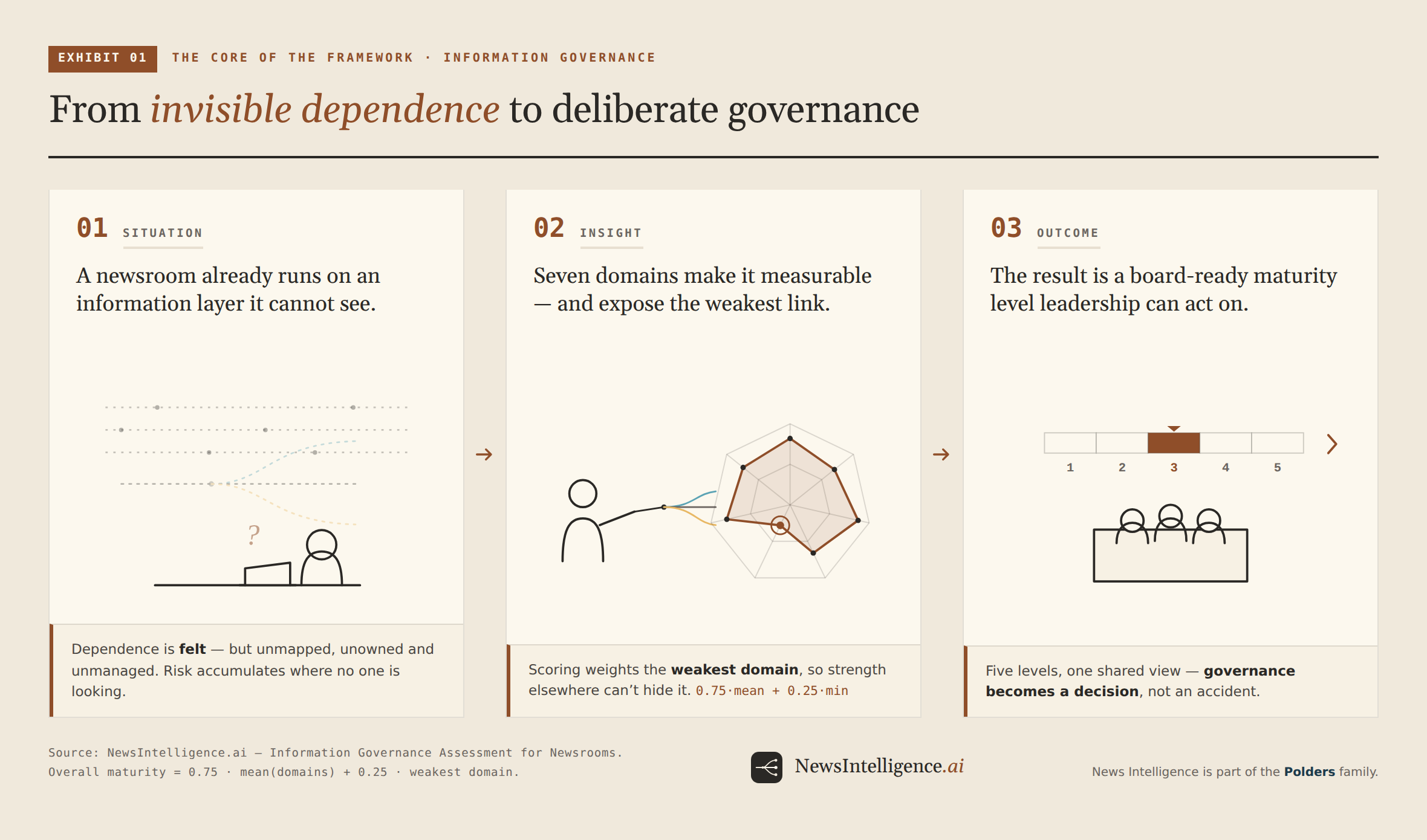
Maturity tends to progress through five stages. In the early stages, governance is reactive and improvised — a response to incidents after they occur. By the later stages it is embedded in how decisions are made, shaping investment, editorial planning and long-term resilience rather than trailing behind them. The value of naming the stages is not to rank organisations but to make the next step legible.
The newsroom recognises that AI dependencies exist, but has not yet mapped them.
Tools are adopted case by case; governance is informal and reactive.
Policies, named owners and review cycles are established and documented.
Information risk is reported alongside financial and cyber risk, on the same cadence.
Governance shapes investment and editorial strategy; the newsroom leads rather than follows.
The reach of Information Governance extends well past editorial operations. It bears on public trust, on organisational resilience, on competitive distinctiveness, and on the long-run independence of the title. These are not soft benefits. Organisations that genuinely understand their information environment make better editorial decisions for a straightforward reason: they operate with more situational awareness than competitors who do not.
There is a competitive dimension worth naming plainly. As generative tools commoditise the production of copy, the durable advantages move upstream — to the quality of a newsroom's questions, the integrity of its sources, and the resilience of the systems behind both. Information Governance is, among other things, the discipline that protects those advantages while competitors are still optimising the parts that no longer differentiate them.
None of this is an argument for slowing down, and it should not be mistaken for one. Governance of this kind is not a brake. By making strategic assumptions explicit and measurable, it is what allows a newsroom to innovate deliberately rather than hopefully — to move quickly because it understands its own exposure, not in spite of failing to.
AI is reshaping journalism because it is reshaping the environment in which editorial judgement takes place. Responsible use of AI remains essential. On its own, it governs the tool and leaves the terrain unmanaged.
Information Governance supplies the wider frame. It asks organisations to govern their digital dependencies, their analytical capability, their editorial plurality, their institutional knowledge and their resilience with the seriousness already extended to finance, cybersecurity and corporate risk. None of these is a technology problem. Each is a strategic one that technology has made urgent.
Journalism will go on depending on human judgement. The task for the coming decade is to ensure the information systems beneath that judgement stay transparent, resilient and aligned with journalism's public purpose. Information Governance is a workable route to that end — one that strengthens, rather than constrains, the independence and plurality on which democratic societies depend.
A governance framework is only as good as the questions it forces leadership to answer. These six are a starting point for a first review.