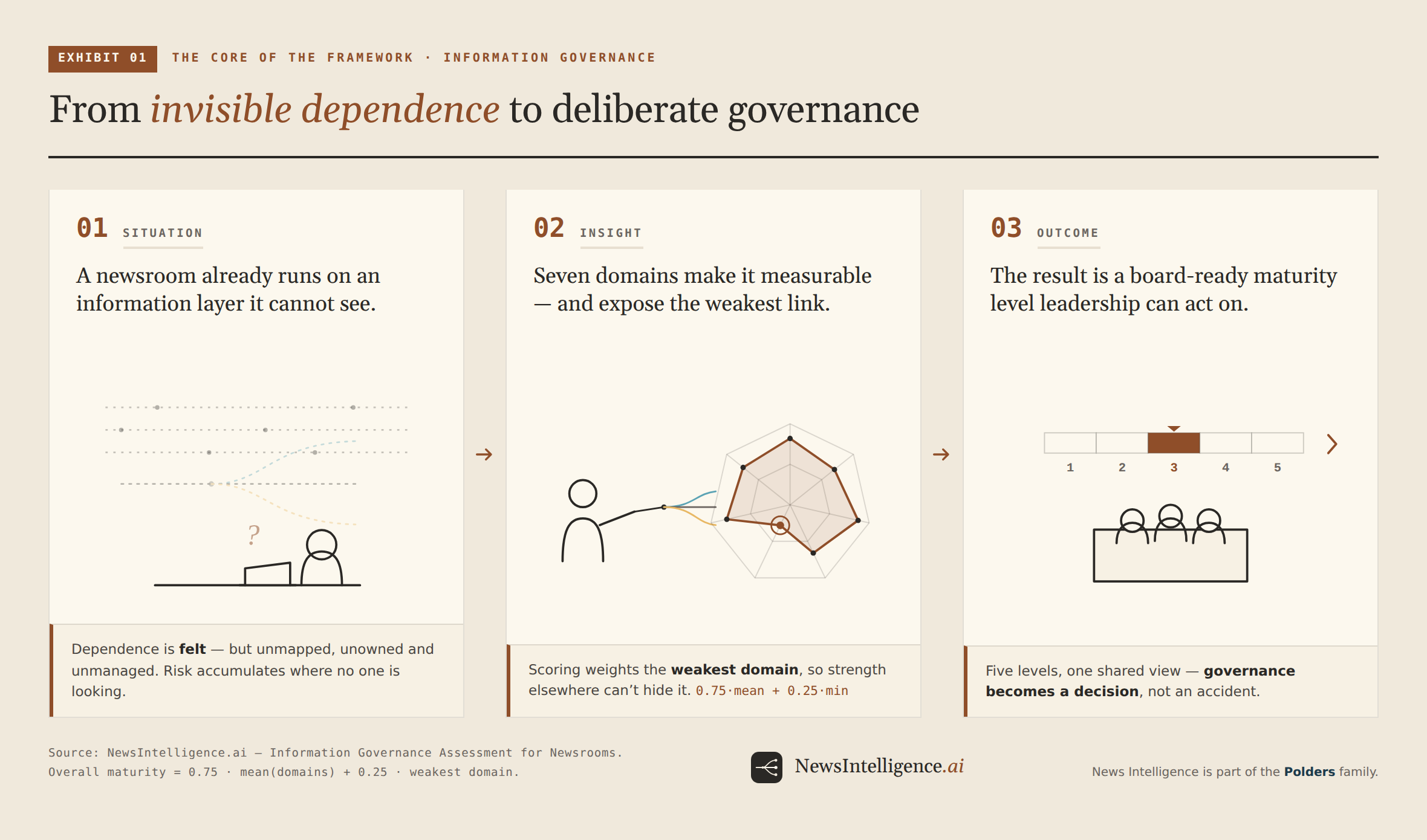
Responsible use of AI has become the easy part. The harder, less-examined question is who governs the information environment that AI now builds around editorial judgement — and on whose terms.
Verantwoord gebruik van AI is inmiddels het eenvoudige deel. De lastigere, minder onderzochte vraag is wie de informatieomgeving bestuurt die AI nu rond de redactionele afweging opbouwt — en op wiens voorwaarden.
AI has stopped being an experiment in the newsroom and become part of its plumbing.
The governance conversation has, reasonably, concentrated on responsible use — human oversight, verification, transparency, accountability. Those disciplines protect editorial integrity and keep the journalist as the final decision-maker. They are necessary. They are also, on their own, no longer sufficient.
The reason is a quieter shift, easy to miss because it happens upstream of the byline. AI systems increasingly organise, filter, rank and connect the information a journalist consumes before any editorial decision is taken. Search, discovery, document analysis, archive retrieval, source identification, synthesis — each is becoming an AI-mediated act. A governance model built solely around AI-as-a-tool leaves the more consequential layer unattended: the information environment itself.
This paper proposes Information Governance as a companion discipline for the AI-enabled newsroom. It does not replace editorial ethics or an AI use policy; it sits alongside them. What it adds is a strategic layer that treats information as critical organisational infrastructure rather than as editorial output. The framework is deliberately technology-neutral, and built to outlast any particular model, vendor or moment.
AI is opgehouden een experiment op de redactie te zijn; het zit inmiddels in de leidingen.
Het gesprek over governance heeft zich, begrijpelijk, geconcentreerd op verantwoord gebruik — menselijk toezicht, verificatie, transparantie, verantwoording. Die disciplines beschermen de redactionele integriteit en houden de journalist de uiteindelijke beslisser. Ze zijn noodzakelijk. En op zichzelf niet langer voldoende.
De reden is een stillere verschuiving, gemakkelijk te missen omdat ze zich stroomopwaarts van de byline voltrekt. AI-systemen ordenen, filteren, rangschikken en verbinden in toenemende mate de informatie die een journalist tot zich neemt vóórdat er een redactionele beslissing valt. Zoeken, ontsluiten, documentanalyse, archiefonderzoek, bronidentificatie, synthese — elk daarvan wordt een door AI bemiddelde handeling. Een governance-model dat uitsluitend om AI-als-instrument is gebouwd, laat de wezenlijker laag onbeheerd: de informatieomgeving zelf.
Deze paper introduceert Informatiegovernance als aanvullende discipline voor de AI-gedreven redactie. Ze vervangt de redactionele ethiek of een AI-gebruiksbeleid niet; ze staat ernaast. Wat ze toevoegt is een strategische laag die informatie behandelt als kritieke organisatie-infrastructuur in plaats van als redactionele output. Het raamwerk is bewust technologieneutraal en gebouwd om elk afzonderlijk model, elke leverancier en elk moment te overleven.
Journalism has absorbed technological upheaval before. The press, broadcast, the web, the social platforms — each reshaped the craft without dislodging its purpose: equipping a society to make informed decisions. The instinct to treat AI as simply the next wave is understandable. It is also mistaken.
AI differs in kind, not merely in degree. Earlier technologies changed how information was produced and distributed. AI changes how it is discovered, weighted and understood — the cognitive work that used to sit squarely inside the newsroom. Editorial judgement now depends not only on professional skill but on the quality and resilience of the digital systems feeding it. When those systems are opaque, editorial judgement inherits their blind spots without knowing it.
By the information environment, this paper means the full set of systems that determine what reaches a journalist's attention and in what shape: the search and discovery tools, the archives and the way they are indexed, the models that summarise and translate, the feeds that prioritise. It is the water the newsroom swims in — and, like water, easiest to ignore precisely because it is everywhere.
Conventional governance treats information as output — the thing produced at the end of the process. Information Governance treats it as infrastructure — the thing everything else stands on. The distinction is subtle and it is decisive. Organisations already govern financial capital, human capital and cybersecurity with board-level seriousness and dedicated reporting lines. Information, which now shapes every editorial decision before it is made, warrants the same.
De journalistiek heeft eerder technologische omwentelingen verwerkt. De drukpers, de omroep, het web, de sociale platforms — elk hervormde het vak zonder het doel ervan te verdringen: een samenleving in staat stellen geïnformeerde beslissingen te nemen. De neiging om AI te zien als simpelweg de volgende golf is begrijpelijk. Ze is ook onjuist.
AI verschilt in aard, niet enkel in gradatie. Eerdere technologieën veranderden hoe informatie werd geproduceerd en verspreid. AI verandert hoe ze wordt ontdekt, gewogen en begrepen — het cognitieve werk dat vroeger onmiskenbaar binnen de redactie lag. De redactionele afweging steunt nu niet alleen op vakmanschap, maar ook op de kwaliteit en veerkracht van de digitale systemen die haar voeden. Waar die systemen ondoorzichtig zijn, erft de redactionele afweging hun blinde vlekken zonder het te weten.
Met de informatieomgeving bedoelt deze paper het geheel van systemen dat bepaalt wat de aandacht van een journalist bereikt, en in welke vorm: de zoek- en ontsluitingstools, de archieven en de wijze waarop ze zijn geïndexeerd, de modellen die samenvatten en vertalen, de feeds die prioriteren. Het is het water waarin de redactie zwemt — en, als water, het gemakkelijkst te negeren juist omdat het overal is.
Conventionele governance behandelt informatie als output — datgene wat aan het eind van het proces ontstaat. Informatiegovernance behandelt haar als infrastructuur — datgene waarop al het overige rust. Het onderscheid is subtiel en het is beslissend. Organisaties besturen financieel kapitaal, menselijk kapitaal en cyberveiligheid al met bestuurlijke ernst en eigen rapportagelijnen. Informatie, die nu elke redactionele beslissing vormt voordat ze wordt genomen, verdient hetzelfde.
Dependence rarely announces itself. It accrues.
Each AI service looks convenient and inexpensive in isolation. Adopted one at a time, on the merits, they are hard to argue against. Taken together, over eighteen months, they harden into infrastructure that no one consciously decided to depend on — and that would be painful, slow, or impossible to replace at speed.
Editorial leadership should be able to answer three questions at any moment: which technologies are load-bearing, where concentration risk sits, and how the newsroom would hold up if a critical service changed its price, its terms, or its behaviour without warning. Most cannot. The dependencies are real; the map of them is not.
The concentration is rarely visible on a single invoice. It shows up structurally: the same provider supplying the model, the cloud it runs on, the search layer above it, and the productivity suite the newsroom drafts in. Each integration deepens the lock-in and raises the cost of leaving. Sovereignty, in this sense, means keeping that cost known and bounded — understanding the exit before the exit is needed.
Digital sovereignty is not a retreat from global technology, nor a nationalist posture dressed as prudence. It is the preservation of informed choice — through awareness of what one relies on, resilience against its failure, and enough diversification that no single provider holds the newsroom's judgement hostage.
Afhankelijkheid kondigt zich zelden aan. Ze sluipt erin.
Elke AI-dienst oogt op zichzelf handig en goedkoop. Eén voor één aangenomen, op hun merites, zijn ze moeilijk te weerleggen. Samen, over achttien maanden, verharden ze tot infrastructuur waarvan niemand bewust besloot afhankelijk te worden — en die pijnlijk, traag of onmogelijk snel te vervangen zou zijn.
De redactieleiding zou op elk moment drie vragen moeten kunnen beantwoorden: welke technologieën dragend zijn, waar concentratierisico zit, en hoe de redactie het zou houden als een kritieke dienst zonder waarschuwing haar prijs, haar voorwaarden of haar gedrag zou wijzigen. De meeste kunnen dat niet. De afhankelijkheden zijn reëel; de kaart ervan niet.
De concentratie is zelden zichtbaar op één factuur. Ze toont zich structureel: dezelfde aanbieder levert het model, de cloud waarop het draait, de zoeklaag erboven en het kantoorpakket waarin de redactie schrijft. Elke integratie verdiept de lock-in en verhoogt de kosten van vertrek. Soevereiniteit betekent in die zin die kosten kenbaar en begrensd houden — de uitgang kennen voordat de uitgang nodig is.
Digitale soevereiniteit is geen terugtrekking uit mondiale technologie, en evenmin een nationalistische pose vermomd als voorzichtigheid. Het is het behoud van geïnformeerde keuze — door besef van waarop men steunt, veerkracht tegen het falen ervan, en genoeg spreiding dat geen enkele aanbieder de afweging van de redactie gegijzeld houdt.
The most valuable thing AI offers a newsroom may not be faster copy. It is a wider field of view.
Framed as a writing aid, AI compresses the last, most visible mile of the process. Framed as an analytical instrument, it does something more interesting: it surfaces relationships across document sets too large to read, detects narratives as they form rather than after they break, and exposes the gaps in a body of reporting — the questions a newsroom has quietly stopped asking.
In practice this reorders where analytical effort goes. The reflex is to ask AI to summarise what a document says. The more valuable question is what a thousand documents, read together, reveal that no single one does — a shift in emphasis, a source quietly dropped, a claim that hardens across a cluster. Used this way, the tool becomes an instrument of attention, directing scarce editorial time toward the stories that would otherwise stay buried in volume.
Information Intelligence is the discipline of pointing AI at the right end of the problem. It uses the technology to ask better questions rather than to manufacture quicker answers. The distinction is commercial as well as editorial: in a market where everyone holds the same generative tools, faster answers converge, but better questions differentiate. Increasingly, editorial value comes from noticing what everyone else has missed.
Het waardevolste dat AI een redactie biedt is misschien niet snellere kopij. Het is een breder blikveld.
Opgevat als schrijfhulp comprimeert AI de laatste, meest zichtbare mijl van het proces. Opgevat als analytisch instrument doet ze iets interessanters: ze legt verbanden bloot in documentverzamelingen die te groot zijn om te lezen, detecteert narratieven terwijl ze ontstaan in plaats van nadat ze losbarsten, en toont de leemten in een corpus aan berichtgeving — de vragen die een redactie stilzwijgend heeft laten vallen.
In de praktijk verlegt dit waar de analytische inspanning naartoe gaat. De reflex is AI te vragen samen te vatten wat een document zegt. De waardevollere vraag is wat duizend documenten, samen gelezen, onthullen wat geen enkel document afzonderlijk prijsgeeft — een verschoven accent, een bron die stilletjes wegvalt, een bewering die zich over een cluster verhardt. Zo gebruikt wordt het instrument een instrument van aandacht, dat schaarse redactietijd stuurt naar de verhalen die anders in het volume bedolven zouden blijven.
Informatie-intelligentie is de discipline om AI op het juiste eind van het probleem te richten. Ze gebruikt de technologie om betere vragen te stellen in plaats van snellere antwoorden te fabriceren. Het onderscheid is commercieel zowel als redactioneel: in een markt waar iedereen dezelfde generatieve tools bezit, convergeren snellere antwoorden, maar onderscheiden betere vragen. Redactionele waarde komt steeds vaker voort uit het opmerken van wat alle anderen hebben gemist.
Plurality is not a nicety of democratic journalism. It is the point.
The risk AI introduces here is subtle and systemic. When competing newsrooms lean on the same underlying models — the same handful of frontier systems, trained on overlapping data, tuned toward similar outputs — they can converge without anyone choosing to. Convergence on phrasing. On which sources feel authoritative. On which frame seems the natural one. The result is a press that looks plural on the masthead and reads as monoculture on the page.
The danger is that convergence is invisible from the inside. Each newsroom makes reasonable local choices; the monoculture is an emergent property no one authored. Only a view across titles reveals it — which is precisely why plurality cannot be self-certified. It has to be observed against the field, and the newsroom that measures it first holds an editorial advantage as much as a civic one.
Governance should therefore treat editorial diversity as something measured, not assumed. Periodic review of source range, framing variety and narrative convergence — across a title's own output and against the wider field — turns an abstract value into an observable signal. Original journalism depends on intellectual variety as much as on factual accuracy. A newsroom that cannot see its own convergence cannot correct it.
Pluriformiteit is geen franje van de democratische journalistiek. Ze is de kern.
Het risico dat AI hier introduceert is subtiel en systemisch. Wanneer concurrerende redacties op dezelfde onderliggende modellen leunen — dezelfde handvol frontier-systemen, getraind op overlappende data, afgestemd op vergelijkbare output — kunnen ze convergeren zonder dat iemand ervoor kiest. Convergentie in formulering. In welke bronnen gezaghebbend aanvoelen. In welk frame het natuurlijke lijkt. Het resultaat is een pers die op de titelpagina pluriform oogt en op de pagina als monocultuur leest.
Het gevaar is dat convergentie van binnenuit onzichtbaar is. Elke redactie maakt redelijke lokale keuzes; de monocultuur is een emergente eigenschap die niemand schreef. Alleen een blik over titels heen legt haar bloot — en juist daarom kan pluriformiteit zichzelf niet certificeren. Ze moet worden waargenomen tegen het veld, en de redactie die haar het eerst meet, houdt een redactioneel voordeel zozeer als een maatschappelijk.
Governance zou redactionele diversiteit daarom moeten behandelen als iets dat wordt gemeten, niet verondersteld. Periodieke toetsing van bronbereik, framingvariatie en narratieve convergentie — over de eigen output en tegen het bredere veld — maakt van een abstracte waarde een waarneembaar signaal. Oorspronkelijke journalistiek steunt op intellectuele verscheidenheid evenzeer als op feitelijke juistheid. Een redactie die haar eigen convergentie niet kan zien, kan haar niet corrigeren.
Choosing an AI model is an editorial decision wearing a procurement disguise.
Models are not interchangeable utilities. Each embeds assumptions about what counts as a good answer, differs in how much of its reasoning it will show, and carries a distinct governance philosophy and risk profile behind a similar-looking interface. Chosen on price and convenience alone, a model imports all of that into the newsroom unexamined — and then shapes output at scale.
A serious evaluation weighs reliability, explainability, continuity, security, provenance and fit with editorial values — and it treats the decision as revisable. A model is not a one-off purchase to be signed off and forgotten. It is a standing relationship, subject to change from the vendor's side as much as one's own, and it deserves scheduled review rather than a single moment of diligence at onboarding.
Continuity deserves particular weight. A model can be deprecated, retrained, or have its behaviour quietly altered between one week and the next, changing the character of everything built on top of it. A newsroom that has not recorded which model produced which output, under which version, cannot audit its own past work — and cannot defend it when challenged.
Een AI-model kiezen is een redactionele beslissing vermomd als inkoop.
Modellen zijn geen uitwisselbare nutsvoorzieningen. Elk model draagt aannames in zich over wat een goed antwoord is, verschilt in hoeveel van zijn redenering het toont, en draagt achter een gelijkende interface een eigen governance-filosofie en risicoprofiel. Gekozen op enkel prijs en gemak importeert een model dat alles ongetoetst de redactie in — en vormt vervolgens de output op schaal.
Een serieuze evaluatie weegt betrouwbaarheid, verklaarbaarheid, continuïteit, veiligheid, herkomst en aansluiting op redactionele waarden — en behandelt de beslissing als herzienbaar. Een model is geen eenmalige aankoop om af te tekenen en te vergeten. Het is een lopende relatie, onderhevig aan verandering van de kant van de leverancier evenzeer als van de eigen kant, en het verdient geplande herziening in plaats van één moment van due diligence bij aanvang.
Continuïteit verdient bijzonder gewicht. Een model kan worden uitgefaseerd, hertraind, of stilletjes van gedrag veranderd tussen de ene week en de volgende, waarmee het karakter verandert van alles wat erop is gebouwd. Een redactie die niet heeft vastgelegd welk model welke output voortbracht, onder welke versie, kan haar eigen eerdere werk niet auditen — en kan het niet verdedigen wanneer het wordt aangevochten.
A newsroom's knowledge is far larger than its published archive.
The archive is the visible part. Beneath it sits the real institutional capability: research methods, the prompts and workflows refined into reliable tools, datasets assembled over years, the metadata that makes any of it findable, and the tacit expertise held in individual heads and habits. Most of this is undocumented. Much of it walks out of the building at each departure and degrades at each system migration.
Prompts are the clearest example. A well-constructed prompt that reliably extracts structure from a messy filing, or surfaces the dissenting source in a document set, is a genuine editorial tool — and it typically lives in one reporter's notes, undocumented and unshared. Treating such artefacts as institutional property, versioned and maintained, is the difference between capability that accumulates and capability that resets with every staffing change.
Knowledge stewardship is the deliberate ownership, documentation and preservation of that capability — so it compounds through technological change rather than leaking away with it. Where AI workflows are built, tuned and discarded quickly, the newsrooms that treat their accumulated methods as assets pull steadily ahead of those that rebuild from memory each time the tools change.
De kennis van een redactie is veel groter dan haar gepubliceerde archief.
Het archief is het zichtbare deel. Daaronder ligt de werkelijke institutionele capaciteit: onderzoeksmethoden, de prompts en workflows die zijn verfijnd tot betrouwbare gereedschappen, datasets die over jaren zijn opgebouwd, de metadata die het geheel vindbaar maakt, en de impliciete kennis in individuele hoofden en gewoonten. Het meeste hiervan is niet gedocumenteerd. Veel ervan loopt het gebouw uit bij elk vertrek en degradeert bij elke systeemmigratie.
Prompts zijn het duidelijkste voorbeeld. Een goed opgebouwde prompt die betrouwbaar structuur haalt uit een rommelig dossier, of de afwijkende bron in een documentverzameling naar boven brengt, is een echt redactioneel gereedschap — en leeft doorgaans in de aantekeningen van één verslaggever, ongedocumenteerd en ongedeeld. Zulke artefacten behandelen als institutioneel eigendom, met versiebeheer en onderhoud, is het verschil tussen capaciteit die zich opstapelt en capaciteit die zich bij elke personeelswissel opnieuw instelt.
Kennisbeheer is het bewust bezitten, documenteren en bewaren van die capaciteit — zodat ze zich opstapelt door technologische verandering heen in plaats van ermee weg te lekken. Waar AI-workflows snel worden gebouwd, bijgesteld en weggegooid, lopen de redacties die hun opgebouwde methoden als bezit behandelen gestaag uit op de redacties die bij elke gereedschapswissel uit het geheugen herbouwen.
Editorial independence is, in practical terms, the ability to keep working on your own terms.
That ability is only as real as the fallback behind it. A newsroom wholly reliant on external AI services for functions it cannot perform without them is independent in principle and captive in practice — a distinction it will discover at the worst possible moment, when a service goes dark, changes materially, or reprices overnight.
Autonomy does not require self-sufficiency in everything, which would be neither realistic nor efficient. It requires a clear line between what the newsroom could reconstitute under pressure and what it genuinely could not — and a deliberate decision about which functions are permitted to sit on the wrong side of that line. Dependence chosen with eyes open is a strategy. Dependence discovered in a crisis is an exposure.
Strategic information autonomy is tested, not assumed. Newsrooms should establish, on a regular schedule, whether their essential functions survive the loss of any single external system. Resilience drills and contingency planning are unglamorous work with no visible payoff until the day they have one. They are also what converts stated independence into the operational kind.
Redactionele onafhankelijkheid is, praktisch gezien, het vermogen om op je eigen voorwaarden te blijven werken.
Dat vermogen is niet reëler dan de terugvaloptie erachter. Een redactie die volledig leunt op externe AI-diensten voor functies die ze zonder die diensten niet kan uitvoeren, is onafhankelijk in beginsel en gevangen in de praktijk — een onderscheid dat ze op het slechtst denkbare moment zal ontdekken, wanneer een dienst uitvalt, wezenlijk verandert of van de ene dag op de andere herprijst.
Autonomie vereist geen zelfvoorziening in alles, wat noch realistisch noch efficiënt zou zijn. Ze vereist een heldere grens tussen wat de redactie onder druk zou kunnen herstellen en wat ze werkelijk niet zou kunnen — en een bewust besluit over welke functies aan de verkeerde kant van die grens mogen liggen. Afhankelijkheid gekozen met open ogen is een strategie. Afhankelijkheid ontdekt in een crisis is een blootstelling.
Strategische informatie-autonomie wordt getoetst, niet verondersteld. Redacties zouden op gezette tijden moeten vaststellen of hun essentiële functies het verlies van elk afzonderlijk extern systeem overleven. Veerkrachtoefeningen en noodplanning zijn ondankbaar werk zonder zichtbaar rendement tot de dag dat het er wel is. Ze zijn ook wat verklaarde onafhankelijkheid omzet in de operationele soort.
Information Governance is not an IT matter to be delegated downward.
The pull to treat it as one is strong — it involves systems, vendors and technical detail, and it is tempting to file under operations. That is precisely the mistake. Every question raised in this paper — dependency, plurality, model choice, institutional knowledge, resilience — is strategic, with consequences for editorial independence and public trust that only leadership can weigh.
Boards, publishers and editors-in-chief should therefore hold explicit oversight of strategic dependencies, information quality, resilience and emerging technological risk, and should receive regular reporting against each — in the same cadence, and with the same seriousness, as financial or cyber risk. At that point information governance stops being an operational footnote and becomes part of institutional strategy.
The reporting need not be heavy. A short standing item — critical dependencies, material changes since the last review, open resilience gaps — is enough to keep the subject in leadership's field of view. What matters is that it recurs on a schedule rather than surfacing only after something has gone wrong, by which point governance has quietly become incident response.
Informatiegovernance is geen IT-kwestie om naar beneden te delegeren.
De neiging om haar zo te behandelen is sterk — ze betreft systemen, leveranciers en technisch detail, en het is verleidelijk haar onder operatie te rubriceren. Dat is nu juist de vergissing. Elke vraag die deze paper opwerpt — afhankelijkheid, pluriformiteit, modelkeuze, institutionele kennis, veerkracht — is strategisch, met gevolgen voor redactionele onafhankelijkheid en publiek vertrouwen die alleen de leiding kan wegen.
Bestuurders, uitgevers en hoofdredacteuren zouden daarom expliciet toezicht moeten houden op strategische afhankelijkheden, informatiekwaliteit, veerkracht en opkomend technologisch risico, en zouden daarover regelmatig moeten rapporteren — in dezelfde cadans, en met dezelfde ernst, als financieel of cyberrisico. Op dat punt houdt informatiegovernance op een operationele voetnoot te zijn en wordt ze onderdeel van de institutionele strategie.
De rapportage hoeft niet zwaar te zijn. Een kort, vast agendapunt — kritieke afhankelijkheden, wezenlijke wijzigingen sinds de vorige toetsing, openstaande veerkrachtlacunes — volstaat om het onderwerp in het blikveld van de leiding te houden. Wat telt is dat het volgens schema terugkeert in plaats van pas op te duiken nadat er iets is misgegaan, waarna governance stilletjes incidentbestrijding is geworden.
A framework earns its keep only when it survives contact with an actual organisation.
Implementation starts with an honest inventory: information assets, AI-supported workflows and external dependencies, mapped as they are rather than as the org chart imagines them. Responsibility is then assigned across leadership, editorial management and technology — named owners, not a committee that collectively owns nothing. Policy sets the standing terms for model selection, knowledge stewardship, resilience testing and periodic review.
The failure mode to avoid is turning this into another compliance ritual — a binder updated annually and read never. Information Governance works as a continuous management discipline: annual reviews, maturity assessments and board-level reporting that evolve in step with the technology they govern. The test of whether it is working is simple. It should change decisions, not merely document them.
Een raamwerk verdient zijn plek pas wanneer het het contact met een werkelijke organisatie overleeft.
Implementatie begint met een eerlijke inventaris: informatiemiddelen, door AI ondersteunde workflows en externe afhankelijkheden, in kaart gebracht zoals ze zijn en niet zoals het organigram ze zich voorstelt. Verantwoordelijkheid wordt vervolgens toegewezen over leiding, redactiemanagement en techniek — met eigenaren bij naam, geen commissie die gezamenlijk niets bezit. Beleid legt de staande voorwaarden vast voor modelkeuze, kennisbeheer, veerkrachttoetsing en periodieke herziening.
De valkuil om te vermijden is dit veranderen in nóg een nalevingsritueel — een ordner die jaarlijks wordt bijgewerkt en nooit gelezen. Informatiegovernance werkt als een doorlopende managementdiscipline: jaarlijkse toetsingen, volwassenheidsmetingen en bestuurlijke rapportage die meebewegen met de technologie die ze bestuurt. De toets of het werkt is eenvoudig. Het hoort beslissingen te veranderen, niet slechts te documenteren.
Maturity tends to progress through five stages. In the early stages, governance is reactive and improvised — a response to incidents after they occur. By the later stages it is embedded in how decisions are made, shaping investment, editorial planning and long-term resilience rather than trailing behind them. The value of naming the stages is not to rank organisations but to make the next step legible.
The newsroom recognises that AI dependencies exist, but has not yet mapped them.
Tools are adopted case by case; governance is informal and reactive.
Policies, named owners and review cycles are established and documented.
Information risk is reported alongside financial and cyber risk, on the same cadence.
Governance shapes investment and editorial strategy; the newsroom leads rather than follows.
Volwassenheid vordert doorgaans door vijf fasen. In de vroege fasen is governance reactief en geïmproviseerd — een reactie op incidenten nadat ze zich voordoen. In de latere fasen is ze ingebed in hoe beslissingen worden genomen, en vormt ze investeringen, redactionele planning en langetermijnveerkracht in plaats van erachteraan te lopen. De waarde van het benoemen van de fasen is niet om organisaties te rangschikken, maar om de volgende stap leesbaar te maken.
De redactie erkent dat er AI-afhankelijkheden bestaan, maar heeft ze nog niet in kaart gebracht.
Tools worden per geval aangenomen; governance is informeel en reactief.
Beleid, benoemde eigenaren en toetsingscycli zijn vastgelegd en gedocumenteerd.
Informatierisico wordt naast financieel en cyberrisico gerapporteerd, in dezelfde cadans.
Governance vormt investeringen en redactionele strategie; de redactie loopt voorop in plaats van achteraan.
The reach of Information Governance extends well past editorial operations. It bears on public trust, on organisational resilience, on competitive distinctiveness, and on the long-run independence of the title. These are not soft benefits. Organisations that genuinely understand their information environment make better editorial decisions for a straightforward reason: they operate with more situational awareness than competitors who do not.
There is a competitive dimension worth naming plainly. As generative tools commoditise the production of copy, the durable advantages move upstream — to the quality of a newsroom's questions, the integrity of its sources, and the resilience of the systems behind both. Information Governance is, among other things, the discipline that protects those advantages while competitors are still optimising the parts that no longer differentiate them.
None of this is an argument for slowing down, and it should not be mistaken for one. Governance of this kind is not a brake. By making strategic assumptions explicit and measurable, it is what allows a newsroom to innovate deliberately rather than hopefully — to move quickly because it understands its own exposure, not in spite of failing to.
Het bereik van informatiegovernance strekt zich ver voorbij de redactionele operatie uit. Ze raakt aan publiek vertrouwen, aan organisatorische veerkracht, aan concurrerend onderscheid, en aan de langetermijnonafhankelijkheid van de titel. Dit zijn geen zachte baten. Organisaties die hun informatieomgeving werkelijk begrijpen, nemen betere redactionele beslissingen om een eenvoudige reden: ze opereren met meer situationeel besef dan concurrenten die dat niet doen.
Er is een concurrentiedimensie die het benoemen waard is. Naarmate generatieve tools de productie van kopij tot commodity maken, verschuiven de duurzame voordelen stroomopwaarts — naar de kwaliteit van de vragen van een redactie, de integriteit van haar bronnen, en de veerkracht van de systemen achter beide. Informatiegovernance is, onder meer, de discipline die die voordelen beschermt terwijl concurrenten nog de onderdelen optimaliseren die hen niet langer onderscheiden.
Niets hiervan is een pleidooi om te vertragen, en het moet ook niet zo worden opgevat. Governance van deze aard is geen rem. Door strategische aannames expliciet en meetbaar te maken, is ze juist wat een redactie in staat stelt doelbewust te innoveren in plaats van hoopvol — snel te bewegen omdat ze haar eigen blootstelling begrijpt, niet ondanks het feit dat ze dat niet doet.
AI is reshaping journalism because it is reshaping the environment in which editorial judgement takes place. Responsible use of AI remains essential. On its own, it governs the tool and leaves the terrain unmanaged.
Information Governance supplies the wider frame. It asks organisations to govern their digital dependencies, their analytical capability, their editorial plurality, their institutional knowledge and their resilience with the seriousness already extended to finance, cybersecurity and corporate risk. None of these is a technology problem. Each is a strategic one that technology has made urgent.
Journalism will go on depending on human judgement. The task for the coming decade is to ensure the information systems beneath that judgement stay transparent, resilient and aligned with journalism's public purpose. Information Governance is a workable route to that end — one that strengthens, rather than constrains, the independence and plurality on which democratic societies depend.
AI hervormt de journalistiek omdat ze de omgeving hervormt waarin de redactionele afweging plaatsvindt. Verantwoord gebruik van AI blijft essentieel. Op zichzelf bestuurt het het instrument en laat het het terrein onbeheerd.
Informatiegovernance levert het bredere kader. Ze vraagt organisaties hun digitale afhankelijkheden, hun analytische capaciteit, hun redactionele pluriformiteit, hun institutionele kennis en hun veerkracht te besturen met de ernst die al aan financiën, cyberveiligheid en ondernemingsrisico wordt besteed. Geen daarvan is een technologieprobleem. Elk is een strategisch probleem dat technologie urgent heeft gemaakt.
De journalistiek zal blijven steunen op menselijk oordeel. De opgave voor het komende decennium is te zorgen dat de informatiesystemen onder dat oordeel transparant, veerkrachtig en in lijn met het publieke doel van de journalistiek blijven. Informatiegovernance is een werkbare route naar dat doel — een die de onafhankelijkheid en pluriformiteit waarop democratische samenlevingen steunen versterkt in plaats van beperkt.
A governance framework is only as good as the questions it forces leadership to answer. These six are a starting point for a first review.
Een governance-raamwerk is niet beter dan de vragen die het de leiding dwingt te beantwoorden. Deze zes zijn een startpunt voor een eerste toetsing.